

 Description English / Français
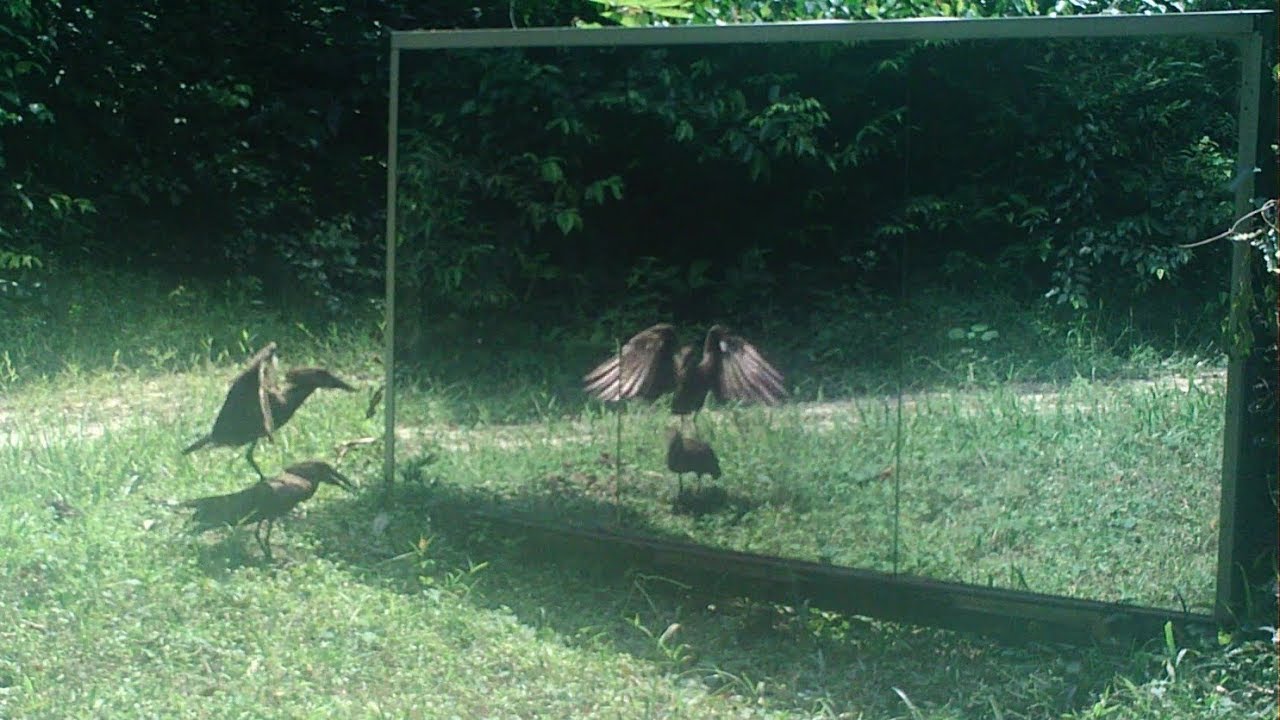
 This sedentary bird is found all over sub-Saharan Africa on the shores of ponds, lakes, swamps, and riverbanks. It owes its English name "Hamerkop" to the shape of its crest and long bill set, which is reminiscent of a hammer's head. It feeds on amphibians, small fish, frogs, shrimps and insects. Pairs build their huge nest at the fork of a tree branch with clay mud mixed with twigs and organic materials.
A particular social behaviour characterising hamerkops pair is the practice of the "false mounting" ceremony, in which one of the two birds, either male or female, stands on the other partner's back and although it seems to mount it, it does not mate.
Anne-Marie and Xavier Michel HUBERT-BRIERRE with Michel GUISS DJOMOU have installed six large mirrors in the gabonese forest. In this uncontrolled and natural environment, multiple cameras have been placed in front of each mirror to be able to film from under different angles and in different distances, the reactions of animals in front of their reflection. On their YouTube channel to watch others amazing videos of wild animals face their reflection and read the descriptions to find out more.
---------------------------------------------
Cet oiseau sédentaire est présent dans toute l’Afrique subsaharienne aux bords des étangs, lacs, marécages, et berges des rivières. Il doit son nom anglais « Hamerkop » à la forme de son ensemble crète plus bec ressemblant à la tête d’un marteau. Il se nourrit d’amphibiens, de grenouilles, de petits poissons, de crevettes et d’insectes. Les couples bâtissent leur nid de taille importante à la fourche d’une branche d’arbre avec le la boue argileuse mélangée à des brindilles et toutes sortes de végétaux.
Un comportement social tout particulier caractérisant les couples d’ombrettes est la cérémonie du « mime de la copulation » au cours de laquelle un des deux oiseaux, indifféremment le mâle ou la femelle, se tient sur le dos de l'autre partenaire et bien que semblant le ou la monter, il ou elle ne copule pas


0 Comments